A Source Is Not Evidence: Why Investment Research Must Go Beyond Information Gathering
Published 21 August 2026
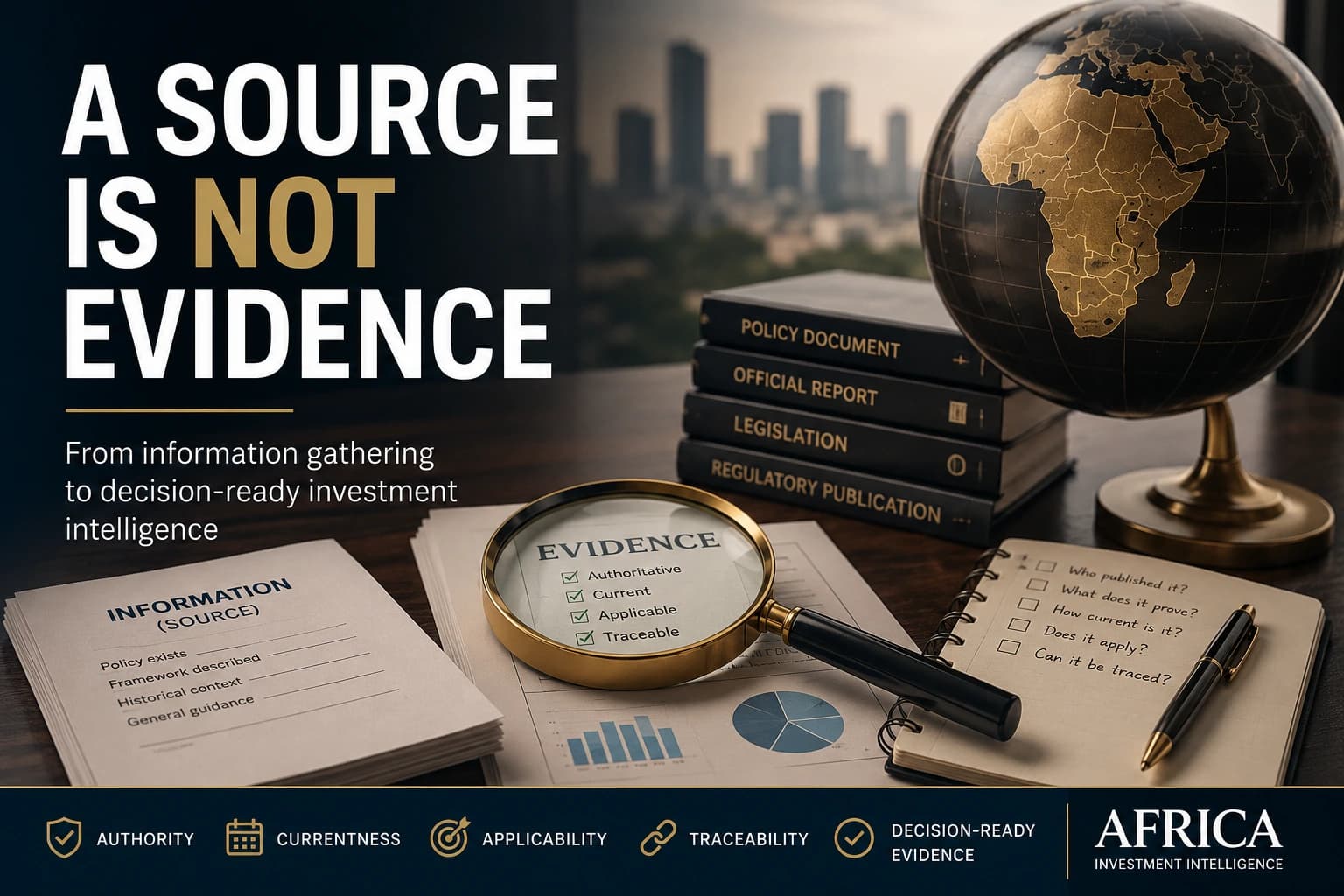
Finding information is easy. Establishing what it actually proves is harder.
The volume of information available to investors has never been greater.
Government websites publish policies and regulations. Central banks release economic data. Investment promotion agencies publish sector reports. Multilateral institutions produce country assessments. Companies publish presentations, financial statements and operating updates.
For anyone researching an African market today, finding information is often relatively easy.
The more difficult task begins afterward:
Can that information actually be relied upon to support an investment decision?
That is where the distinction between a source and evidence becomes important.
A source tells us where information came from.
Evidence tells us what can reasonably be concluded from it.
The two are related, but they are not the same.
Finding the document is only the beginning
Consider a government policy document announcing a new investment incentive.
Its existence may be easy to verify. It may sit on an official ministry website and carry the name of the relevant institution.
That makes it an important source.
But several questions remain before an investor can rely on it.
Was the policy formally adopted?
Has it entered into force?
Has it subsequently been amended?
Is it still current?
Does it apply to every investor, or only to certain sectors, locations or types of investment?
Are there implementing regulations?
Does another authority interpret or administer the policy differently?
The document may be completely authentic while still being insufficient to answer the investor's actual question.
That distinction matters.
Investment research becomes vulnerable when the existence of information is mistaken for proof of a conclusion.
Authority matters, but authority is not enough
The first question in evidence-based investment research should be:
Who is speaking?
Not all sources carry the same evidentiary weight.
An official statistical release, legislation, regulatory decision or central bank publication generally provides a stronger basis for certain factual claims than a newspaper summary or third-party commentary.
But even an authoritative source has boundaries.
A central bank may be authoritative on monetary policy and banking regulation but not necessarily on land ownership.
An investment promotion agency may accurately describe incentives available to investors, while the underlying legal conditions are ultimately determined by legislation, tax authorities or sector regulators.
A multilateral institution may provide an excellent interpretation of the economic environment, but its analysis should not automatically be treated as the primary legal authority for domestic regulation.
Good research therefore asks not simply:
Is this an official source?
It also asks:
Is this the right authority for the specific proposition we are trying to establish?
Evidence must be tied to a precise claim
This is one of the most important disciplines in investment intelligence.
Research becomes stronger when every material conclusion can be broken into propositions that can be independently tested.
Suppose an investor wants to know whether foreign ownership is permitted in a particular industry.
A broad investment guide stating that a country welcomes foreign investors is not enough.
The real questions may include:
- Can a foreign investor own 100% of the operating company?
- Are there sector-specific ownership restrictions?
- Is local participation required?
- Can land be owned, or only leased?
- Does a change of control require regulatory approval?
Each question may require different evidence.
This is why broad market descriptions are useful for orientation but insufficient for serious due diligence.
Decision-ready research must identify exactly what a source proves — and just as importantly, what it does not prove.
Currentness is part of evidentiary quality
A second challenge is time.
Historical documents can be authentic, authoritative and extremely useful.
But historical truth is not necessarily current truth.
A law enacted in 2018 may have been amended in 2023.
An investment incentive announced in 2021 may have expired.
A regulatory institution may have changed its mandate.
A tax rate may have been replaced in a subsequent budget.
A bilateral agreement may have been signed but never entered into force.
This creates one of the most common risks in investment research:
using historically accurate information to describe the present without establishing that the position remains current.
For investors, that distinction can have real consequences.
The question is not only:
Was this true?
It is also:
Is this still true at the point when the investment decision is being made?
Currentness should therefore be treated as part of the evidence itself rather than as a final editorial check.
Applicability matters as much as accuracy
Information can also be accurate without applying to the investor in question.
A tax incentive may exist but apply only inside a designated economic zone.
A foreign-ownership rule may differ between banking, mining, telecommunications and agriculture.
A regional agreement may create obligations at the international level while questions remain about implementation or domestic effect.
An investment protection may apply only to investors meeting particular nationality, structure or registration requirements.
This means an investor cannot stop at asking whether a rule exists.
The more important question is:
Does this rule apply to this investor, in this sector, under this structure, at this time?
That is the point at which general market research begins to become investment intelligence.
Traceability creates institutional confidence
The distinction between sources and evidence becomes even more important when research reaches an investment committee.
Decision-makers need more than persuasive prose.
They need to understand the basis for the conclusion.
A strong research process should make it possible to move backwards from a conclusion to the evidence supporting it, and from the evidence to the original source.
That creates traceability.
A useful discipline is to ask five questions for every material investment conclusion:
- Authority — Is this the institution competent to establish the fact?
- Proposition — What exactly does the source prove?
- Currentness — Is the information still valid for the decision date?
- Applicability — Does it apply to this investor, transaction, sector or jurisdiction?
- Traceability — Can another reviewer independently reproduce the conclusion from the underlying evidence?
If one of those questions cannot be answered, the appropriate response is not to hide the uncertainty.
It is to record it.
That can be more valuable to an investor than an artificially definitive answer.
Unresolved questions are part of good research
There is a natural temptation in research to produce certainty.
Investors ask questions, and researchers are expected to provide answers.
But credible investment intelligence sometimes requires saying:
The available evidence does not yet establish this.
That is not a research failure.
It is evidence discipline.
If two official sources conflict, the conflict should be visible.
If a publication date cannot be established, it should not be invented.
If a historical document proves that a framework once existed but does not establish its current status, the limitation should remain attached to the conclusion.
If a secondary source reports a regulatory position that cannot yet be confirmed from the responsible authority, that distinction should be preserved.
This is particularly important in markets where information can be fragmented across ministries, regulators, official journals, agencies and regional institutions.
The objective should not be to eliminate every uncertainty.
It should be to make the boundary between verified fact, reasonable inference and unresolved question unmistakably clear.
From market information to decision-ready intelligence
African markets do not suffer from an absolute shortage of information.
There are extensive datasets, policy documents, laws, regulatory publications, investment guides, development reports and sector studies available across the continent.
The challenge is that this information is often dispersed across institutions and published with different levels of authority, currentness and accessibility.
For investors, the real value increasingly lies in converting that fragmented information into a structured body of evidence.
That requires more than collecting documents.
It requires verification.
It requires comparison.
It requires currentness testing.
It requires understanding institutional responsibility.
It requires identifying contradictions and limitations.
And it requires maintaining a clear line between what has been established and what remains uncertain.
This becomes particularly important as an opportunity progresses from initial market exploration toward due diligence, transaction structuring and investment committee approval.
At that stage, a persuasive narrative is not enough.
The investor needs confidence that the underlying assumptions can withstand scrutiny.
The investment advantage may be better evidence
Much of the discussion around investment in Africa focuses on capital availability, project pipelines and investor appetite.
Those issues matter.
But another constraint deserves greater attention:
the quality of the evidence connecting capital to opportunity.
An attractive opportunity that cannot be independently verified may struggle to secure institutional capital.
A promising market supported by outdated assumptions may create avoidable risk.
A strong project presented without transparent evidence may require significantly more due diligence before an investor can proceed.
Improving the quality, traceability and currentness of investment information can therefore become part of the investment infrastructure itself.
Because confidence is not created simply by providing investors with more information.
It is created by helping them understand:
what is known, how it is known, how current it is, what it applies to, and what remains unresolved.
That is the difference between information gathering and investment intelligence.
And it is why, in serious investment research:
A source is not the same as evidence.
Disclaimer. This article describes our general approach to evaluating investment research sources. It does not itself constitute investment advice or a recommendation regarding any market, sector, or opportunity.